


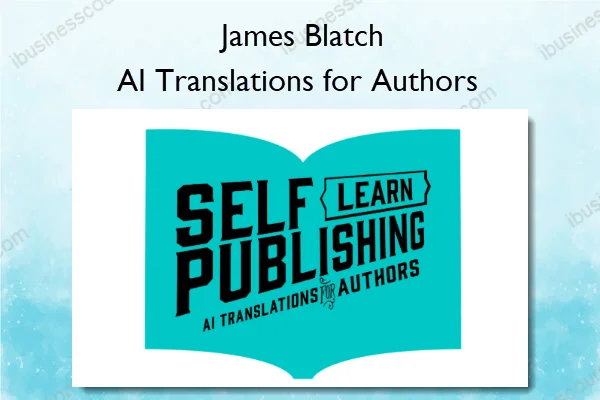
AI Translations for Authors – James Blatch
Original price was: $399.00.$39.00Current price is: $39.00.
»Delivery: Within 7 days
AI Translations for Authors – James Blatch
Translating a book the old-fashioned way costs thousands of dollars — something that’s kept indie authors out of foreign markets for over a decade. But even with AI, simply throwing a whole novel at an LLM gets highly inconsistent results; obvious errors like grammar, tense and voice, but also subtler changes you’ll probably never notice, such as revealing the gender of a mystery character, or a clunky idiom that shifts the meaning of your original.
That’s because an AI isn’t a person. It has no idea that a dark interrogation scene needs different pronoun choices than a love scene. It can’t distinguish a deliberate storytelling choice from a mistake it needs to correct.
Fortunately, there’s a solution — one built specifically for indie authors willing to put in a little work.
Preparation is the Key to Translating Success
That’s right – the bulk of the work required to achieve a professional-quality end result happens before a single word gets translated.
The approach inside AI Translations for Authors focuses on a “multi-pass” system, starting with a Global Style Sheet – a comprehensive language bible built for each individual book, covering grammar rules, speech marks, voice, formal and informal address, character relationship dynamics, idioms, and long-running subtleties such as recurring jokes.
Yes, this sounds like a lot. But by giving the AI a detailed roadmap up front, it can work in smaller, manageable chunks while retaining the full picture of the novel. The result is consistency and quality across the entire translation – something notoriously difficult to achieve even with human translators.
I’ll show you which prompts to use to set up your own high-quality translation production line. And once it’s set up, you won’t have just one translated title – you’ll have the means to produce books suitable for multiple languages and foreign markets.
What You’ll Learn In AI Translations for Authors
Introduction
- Session 1 Overview of the course
- Session 2 Meet your instructor
- Session 3 Why you should be translating?
- Session 4 A guide to the various markets
- Session 5 Rights and copyright
Getting Started
- Session 1 The AI/LLM engines we will use
- Session 2 Your Translation Workflow
- Session 3 Dialogue Punctuation Guide
- Session 4 French Narrative Voice
The Workflow
- Session 1 The Workflow
- Pass 1 Create A Global Style Sheet
- Pass 2A Chapter Translation Prompt
- Pass 2B ScribeShadow Workflow
- Pass 3 The Accuracy Check
- Pass 4 The Line Edit
- Pass 5 The Consistency Check
Your title and cover
- Session 1 Creating a title that sells
- Session 2 Creating a blurb that sells
More courses from the same author: James Blatch
Related products

»Instant Delivery
»Instant Delivery
»Instant Delivery
»Instant Delivery
»Instant Delivery
»Instant Delivery
»Instant Delivery

»Instant Delivery